PolicyLenzCompliance analysis engine

The compliance analysis engine that runs inside your perimeter.

PolicyLenz assesses your security policies against NIST CSF 2.0, ISO/IEC 27001:2022, SOC 2, GDPR, and DORA: quantitative scores, clause-level gaps, and audit-ready remediation, delivered by a sealed, single-tenant engine: self-hosted inside your perimeter, or as a private instance we run for you.

  • Self-hosted or private cloud
  • 358 controls enumerated
  • Audit-ready by design
Fig. 0  Illustrative run
Your perimeterISO/IEC 27001 · 93SOC 2 · 61GDPR · 36NIST CSF 2.0 · 106DORA · 62Enumerated, not retrieved358of 358 controls assessedScored per frameworkDatabaseYours aloneEgressDefault-deny0 AI hostsapi.anthropic.comAllow-listedNo externalAI hostLocal engineSigned modelSingle-tenantSealedSample policy4 frameworks
ISO 27001
67.793/93
SOC 2
63.961/61
GDPR
79.236/36
NIST CSF
61.8106/106
DORA
63.762/62
Full 1.0Partial 0.5Missing 0.0
§ 01The problem

Gap assessments are stuck between two bad options.

Option AThe manual way

Slow and consultant-bound.

A framework gap assessment means weeks of a consultant reading policies line by line against hundreds of controls. It is expensive, it goes stale the moment a policy changes, and the working notes rarely survive to the next audit cycle.
Option BThe chatbot way

Fast and unaccountable.

Pasting policies into a general-purpose AI chat gives you answers nobody can verify: coverage is incomplete, the score changes every time you ask, and your most sensitive documents just left your perimeter. No auditor accepts "the chatbot said so".

§ 02Why PolicyLenz is different

An engine, not an AI chat.

A chat wrapper sends your document to a model and formats the reply. PolicyLenz is a deterministic pipeline in which the model is one bounded, replaceable component: the catalogs, the scoring, the merge rules, and the audit trail are all engine code, not prompts.
  1. 01

    Every control, every time.

    The framework catalogs are enumerated structured data, not a retrieval index. All 358 controls are assessed on every run, so gaps can never be silently dropped.

  2. 02

    Deterministic scoring.

    Fixed weights, a reproducible merge across document chunks, and no cross-framework averaging. The engine computes the numbers; the model never invents them.

  3. 03

    An engineered LLM boundary.

    Structured output through forced tool use, computed token budgets, and an explicit retry ladder with model fallback. A failed framework degrades a run to partial instead of poisoning it.

  4. 04

    The engine grades the AI.

    Policies drafted by the built-in generator are validated by the same analyzer that grades everything else, then revised in a loop until they clear the bar.

Input01 Chunk02 Enumerate03 Merge04 Score05 PersistC1C2C3C4C5ISO/IEC 27001 · 93 controlsSOC 2 · 61 criteriaGDPR · 36 obligationsNIST CSF 2.0 · 106 subcategoriesDORA · 62 requirements67.763.979.261.863.7Never averagedImmutable

Documents are split once, snapping to section boundaries, with overlap so nothing falls between the cracks.

Walk through the whole pipeline
§ 03The workflow

From upload to audit‑ready in five steps.

  1. 01

    Upload

    Bring your policy documents plus any supporting evidence. DOCX and PDF, up to ten documents per run.

  2. 02

    Analyze

    One pass per framework over every control. Automatic framework detection or pick your own set.

  3. 03

    Review gaps

    Clause-level findings with per-function breakdowns, crosswalk hints, and two honest numbers: effective and policy-only.

  4. 04

    Remediate

    PolicyLenz proposes a change set. You accept, edit, or reject each change in a word-level diff review.

  5. 05

    Export

    PDF, DOCX, XLSX, and CSV, including scope, coverage provenance, dispositions, and the decision log.

policylenz.internal
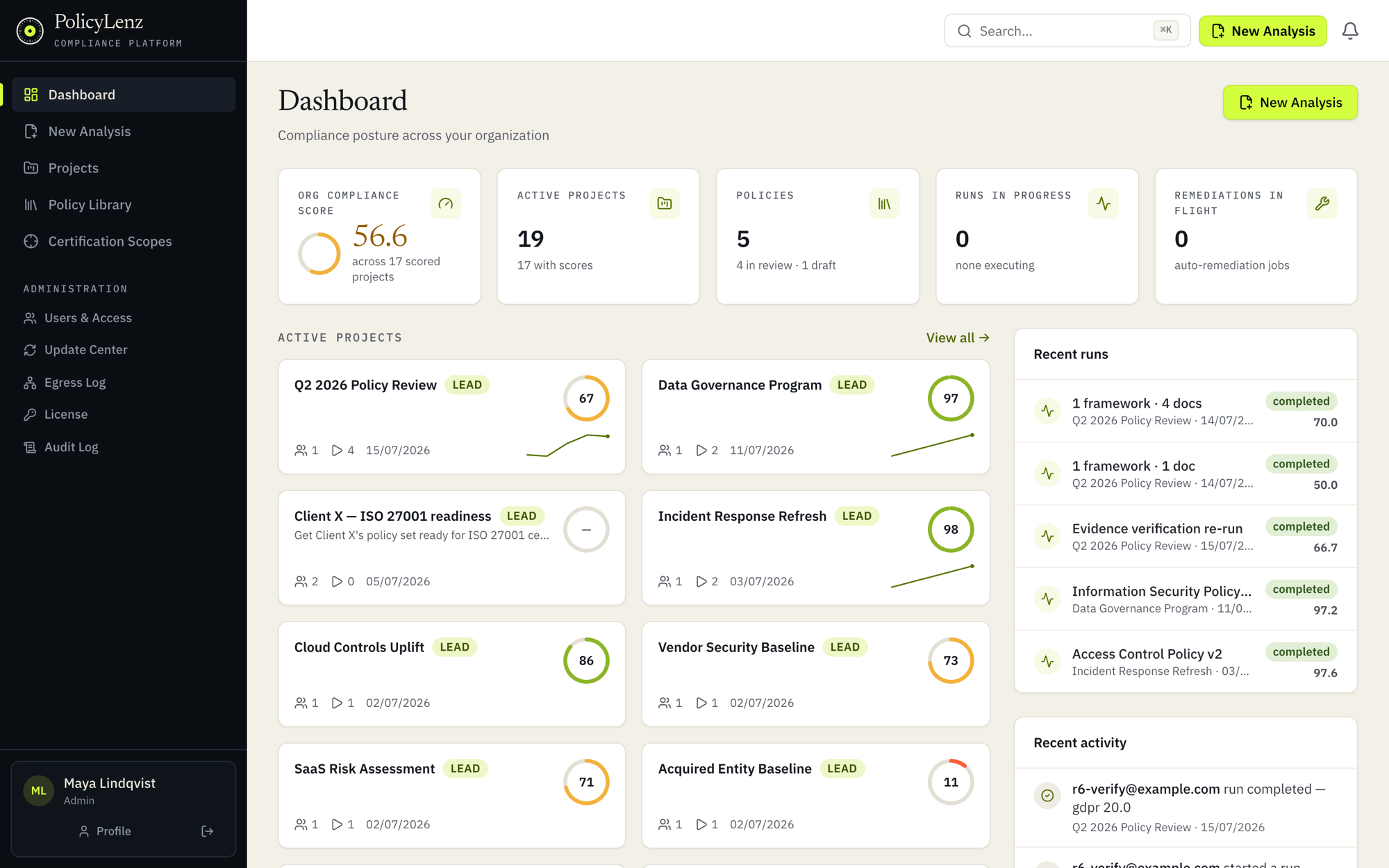
PolicyLenz dashboard with the organization compliance score, scored project cards, and recent runs
Fig. 1The dashboard: organization compliance score, scored projects, and recent runs. A real capture from the product.
Explore the full product
§ 04Frameworks

Five frameworks, one consistent engine.

Every framework normalizes to the same structure, so a run can assess one document set against all five at once. 408 curated crosswalk mappings connect related controls across frameworks, and they are deliberately report-only: a mapping never changes a score.
Certification standard01

ISO/IEC 27001:2022

93Annex A controls

93 Annex A controls across 4 themes

Attestation framework02

SOC 2

61criteria

61 criteria across all five Trust Services Categories

Privacy regulation03

GDPR

36obligations

36 obligations across 4 areas

Voluntary framework04

NIST CSF 2.0

106subcategories

106 subcategories, verbatim official text

Financial-sector regulation05

DORA

62requirements

62 requirements across 5 pillars

Need a different framework? The engine adapts
§ 05Security & trust

Your documents stay yours.

PolicyLenz is sealed and single-tenant, whether self-hosted on your infrastructure or run for you as a dedicated private instance. In the Cloud AI edition the only network egress is the model API, and even that is governed, logged, and visible. In the Local edition the model runs on your own machine and no AI traffic leaves it.
Read the full security posture
Egress ledger· Illustrative
  1. 09:41:07api.anthropic.comallowed
  2. 09:41:02api.anthropic.comallowed
  3. 09:40:55cdn.example.netdenied
  4. 09:40:49api.anthropic.comallowed
  5. 09:40:41api.anthropic.comallowed
  6. 09:40:36api.anthropic.comallowed
  7. 09:40:28api.anthropic.comallowed
6
Allowed
Local calls
1
Denied
10
External AI hosts
Allow-list: api.anthropic.com. Everything else is refused and recorded.Allow-list: no AI hosts. The engine runs on the host; its calls appear as local.
  • S-01

    Default-deny egress

    One allow-listed host in the Cloud AI edition, none for AI in the Local edition. Every attempt, allowed or denied, lands in a visible egress ledger.

  • S-02

    Signed content updates

    Framework updates are Ed25519-signed, downgrade-proof, atomically installed, and one-click reversible.

  • S-03

    Immutable audit trail

    Versions are immutable, runs pin what they assessed, and raw verdicts are never rewritten.

  • S-04

    Enterprise access control

    Five app roles, invite-only onboarding, TOTP MFA with org-wide enforcement.

  • S-05

    Human-gated remediation

    The AI proposes. Every applied change carries a named human decision.

  • S-06

    Nothing extra in the box

    No embedding or vector libraries ship in the application image. The Local edition adds exactly one inference component and one signed model file, both listed with checksums.

§ 06Deployment

Two ways to run it.

Same appliance, same single-tenant isolation, different operator. Nobody gets a shared platform, and Self-Hosted also lets you choose where the AI model runs.
Self-Hosted
Cloud AI edition
Who operates it
You, on your own infrastructure: your machines, your database.
Where documents live
A database you own, inside your network.
Where the model runs
Anthropic's Claude, reached over one allow-listed host. Your own API key if you prefer.
Network egress
One allow-listed host. Every attempt, allowed or denied, in the ledger.
Built for
Organizations where policy documents must not cross the boundary.
Self-Hosted
Local edition
Who operates it
You, on your own hardware: your machines, your database.
Where documents live
A database you own, on the same machine as the engine.
Where the model runs
A bundled open-weight engine on your own hardware.
Network egress
None for AI. The ledger shows only local engine calls.
Built for
Organizations where policy documents must not cross the boundary.
PolicyLenz Cloud
Private instance
Who operates it
We do. A dedicated instance we provision and operate for you.
Where documents live
That instance's own database, at your own address. Nothing shared with anyone.
Where the model runs
The model API, called only from your dedicated instance.
Network egress
Only the model API, under the same rules as the Cloud AI edition.
Built for
Teams that want the results without running infrastructure.
How both models keep your documents yours
§ 07By the numbers
Frameworks
5
Controls enumerated
358
Crosswalk mappings
408
Table data model
31
Automated tests
679
Architectures
2
§ 08Who it's for

Built for the people who own the audit.

For

Internal compliance teams

Continuous readiness between audits. Track effective scores per project, resolve gaps with evidence, and keep a record an auditor can reconstruct.

For

Advisory firms and vCISOs

Per-client projects, reusable certification scope profiles, and multi-framework runs map directly to how engagements actually work.

For

Audit preparation

Evidence with provenance, dispositions with mandatory justification, and exports that show who decided what, and when.

Next step

See your own policy scored in 30 minutes.

A live walkthrough on your sample policy, offline, with your questions answered by the people who built it.